The loudest request is not always the real problem. I map the workflow before choosing the interface.
I build best when
the problem is still messy.
I learn the workflow, make the constraints visible, build the smallest reliable system, and stay for the production reality.

Software became the way I improve operations.
I started in retail and warehouse operations, where problems were immediate: a customer needed the right answer, a shelf was empty, a shipment was wrong, or a team needed a clear priority.
At ESDC, that operational thinking moved into secure federal APIs. At Canadian Bank Note, it expanded into testing, country implementations, online passport workflows, payments, and production support.
Recent agency and product work has added TypeScript, React, cloud deployment, internal tools, analytics, and AI-assisted delivery. The tools changed. The working habit did not.
Three rules I keep returning to.
Transactions, idempotency, tenant isolation, validation, and tests carry more trust than optimistic copy.
A green build is not production proof. I check data, APIs, deployment behavior, handoff, and failure recovery.
Software is how I improve the operation.
I start with how people work, then choose the right system. AI can research, classify, draft, extract, or route, but models only become useful when software gives them structure, tools, safeguards, and a clear human decision.
Public GitHub is only part of the work.
The public profile currently holds 9 repositories. Much of my recent work is in private repositories and internal systems, so the public contribution graph is not a complete picture.
The graph shown here is a private-inclusive screenshot supplied by Ayub and captured September 3, 2026. It is not independently verifiable from the public profile.Open GitHub profile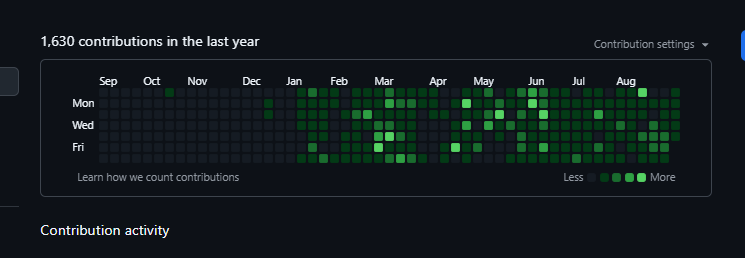
1,630 contributions in the last year, including private repositories.
Curious, practical, and happiest near the real problem.
Outside the work, I keep learning through product experiments, systems research, and building tools for the people around me.
Email Ayub